🔒 This case study focuses on my process and approach. All visuals and data are publicly available or modified for confidentiality.
Prioritized for product roadmap
Informing product strategy on ad rejections with TikTok Ads
TIMELINE
Jun – Sept 2025
ROLE
Mixed-Methods UX Research Intern
ORG
TikTok: Global Business Monetization Team
METHODS
Interviews, Usability Testing, Survey Design
WHY THIS RESEARCH MATTERED
Advertisers struggled to recover from ad rejections
Why their ad was flagged
Rejection notices arrived without enough context to determine whether the issue was policy-related, creative-related, or technical.
How to fix it and resubmit
Advertisers were left guessing. Edit the creative? File an appeal? Contact support? Each path felt opaque with no clear next step.
What specifically triggered it
Without knowing if it was the visual, the copy, or targeting, advertisers couldn't make informed edits, so violations kept repeating.

↑ Increased
Repeat violations
↓ Decreased
Advertiser trust
⏱ Delayed
Campaign recovery
No single team saw the full recovery journey

…so I mapped the end-to-end advertiser journey to connect fragmented touchpoints into a clearer picture of the advertiser recovery experience.
Research Questions
The questions ranged from how they find out about a rejection, to how they resolve it (or don’t)
Discovery & awareness
How do advertisers first find out about rejections?
What types of rejection notices do they receive?
Troubleshooting behavior
How do advertisers approach fixing rejected ads, if they do?
What drives decisions to edit vs appeal?
Decision making & clarity
Is it clear how to move forward after a rejection?
Where do advertisers experience confusion, if at all?
Support & comparison
Where do advertisers seek help, if they do?
How does this rejection experience compare to other platforms they advertise on?
Research Artifacts
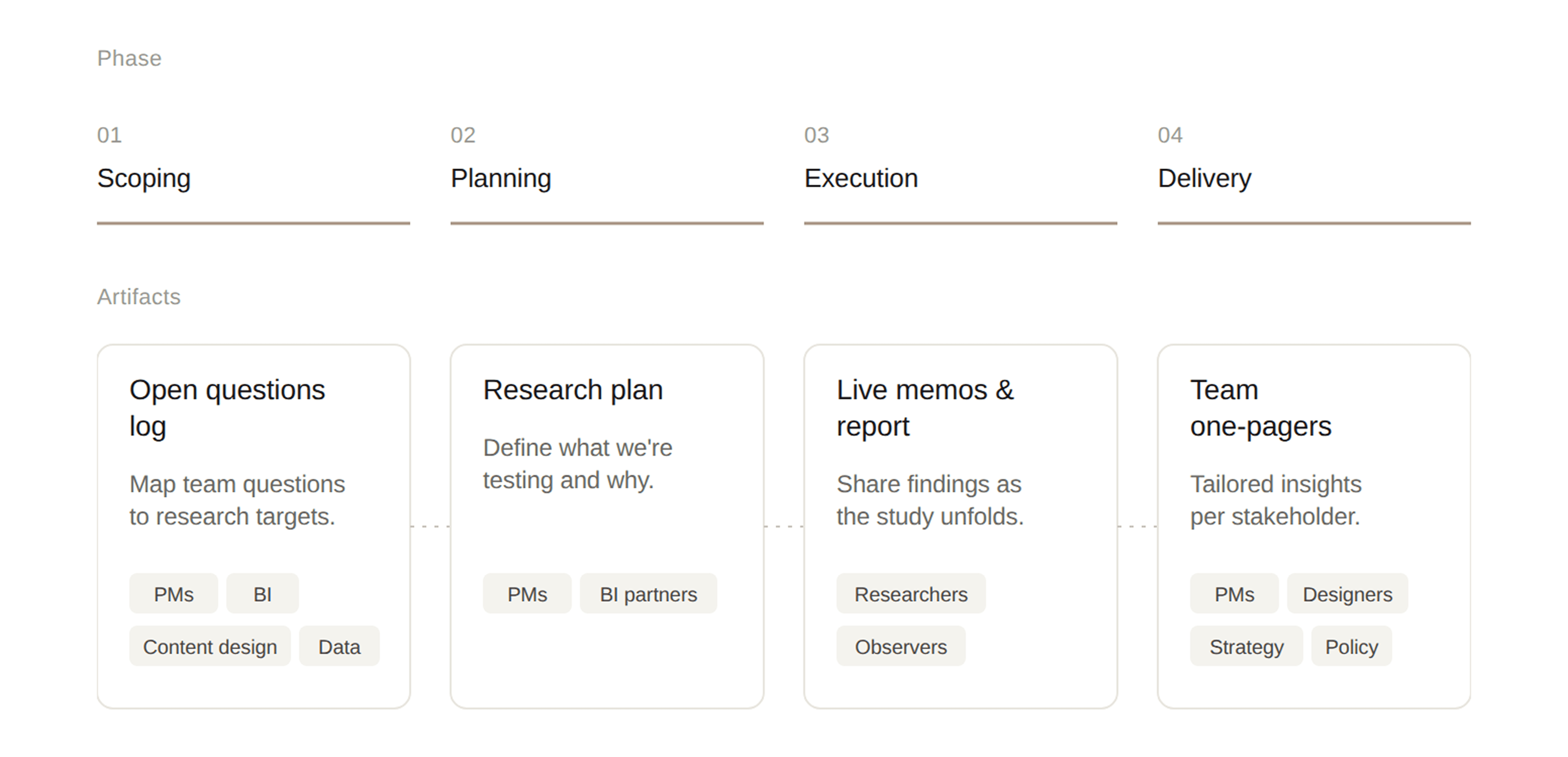
The research included a chain of artifacts, each tuned to a different audience and moment
Open questions surface intent. The plan locks scope. Live memos keep stakeholders close to the work. One-pagers translate findings into team-specific decisions.
Research Process
I moved from broad exploration to targeted validation, building progressively to surface both mental model gaps and usability breakdowns
Phase 01
Secondary Research
Competitive analysis and heuristic review of TikTok's existing rejection flows to identify known gaps before fieldwork.
Phase 02
Generative Study
Semi-structured interviews to understand advertiser mental models, emotional responses, and coping strategies around rejection workflows.
Phase 03
Moderated Usability
Task-based usability sessions in TTAM where participants navigated real rejection scenarios while thinking aloud.
Phase 04
Synthesis and Delivery
Affinity mapping, prioritization workshops with PMs and Designers, and a research report shared across all stakeholder groups.
We spoke to 16 participants across the advertiser ecosystem

Findings AND IMPACT
The findings revealed a breakdown in communication
I'm highlighting some of the key findings
Email is the first and most trusted touchpoint, but it's failing advertisers.
"I would say the email is more of a notification to go check in, but it doesn't really give me any actionable insights in terms of like, what do I need to do to fix it." — Participant #6
Advertisers can’t quickly find what to fix in rejection emails

Clear, actionable fixes surfaced at the top

Why it matters
When the first alert isn't actionable, advertisers spend time digging for answers instead of addressing the problem. Over time, they're being trained to ignore emails altogether.
Recommendation
Redesign rejection emails to include the specific policy violated, a plain-language explanation, and direct deep-links to the rejection details view in TTAM and relevant policy documentation.
TTAM is the main destination for rejection details, but lacks what advertisers need to make edits or appeal.
"It could definitely be more specific. In terms of like, I don't know what this number is. No one knows what this number means unless you're a computer." — Participant #2
Advertisers can’t quickly find what to fix in rejection emails

Clear, actionable fixes surfaced at the top

Why it matters
Without clear, immediate solutions in TTAM, advertisers hesitate — often pausing ads instead of fixing them. This delays recovery, wastes spend, and misses revenue.
Recommendation
Provide contextual, actionable rejection reasons — go beyond general policy references. Suggest concrete fixes: "try trimming the last 3 seconds" or "remove the word X from your ad copy."
Policy language creates a comprehension barrier, not a compliance barrier.
"I would say the email is more of a notification to go check in, but it doesn't really give me any actionable insights in terms of like, what do I need to do to fix it." — Participant #6
Advertisers can’t quickly find what to fix in rejection emails
Clear, actionable fixes surfaced at the top
Why it matters
Most advertisers wanted to comply — they just couldn't decode the policy language. The problem isn't lack of intent; it's lack of clarity.
Recommendation
Replace or supplement policy references with plain-language summaries, practical examples of violations, and 'what this means for your ad' explainers.
The appeal flow is buried, broken, and destroys trust.
"I would say the email is more of a notification to go check in, but it doesn't really give me any actionable insights in terms of like, what do I need to do to fix it." — Participant #6
Advertisers can’t quickly find what to fix in rejection emails
Clear, actionable fixes surfaced at the top
Why it matters
Only 2 of 8 usability participants successfully located and completed an appeal without assistance. The remaining 6 gave up or chose to edit and resubmit instead.
Recommendation
Surface the appeal option prominently within the rejection details view. Add a confirmation state, expected SLA, and status tracking. Make it feel like a legitimate path, not a last resort.
Repeat rejection without explanation accelerates platform abandonment.
"I would say the email is more of a notification to go check in, but it doesn't really give me any actionable insights in terms of like, what do I need to do to fix it." — Participant #6
Advertisers can’t quickly find what to fix in rejection emails
Clear, actionable fixes surfaced at the top
Why it matters
Advertisers who experienced multiple rejections without explanation began to question the reliability of TikTok as an advertising platform. Several had started shifting budget to Meta or Google.
Recommendation
Design for the repeat-rejection journey. When a second rejection occurs in 30 days, trigger a proactive support outreach with personalized guidance based on the specific violations.
Reflection
If I had more time…
There were several directions I would have loved to dig deeper into given more bandwidth or timeline.
01
Scale up across regions
Run the study with more participants across different regions to explore how cultural and regulatory differences shape how advertisers interpret rejection notices — especially in emerging and compliance-heavy markets.
02
Longitudinal tracking of advertiser behavior
Measure the impact of changes on time-to-resolution, repeat rejection rates, and campaign recovery over several months, validating whether the redesigned flows actually improved outcomes.
03
Usability test redesigned notifications
Validate whether changes to email templates and in-product flows actually improve advertiser comprehension, trust, and speed to action — closing the loop on our core recommendations.